
BMR Calculator: Calculate Your Basal Metabolic Rate
A BMR calculator estimates the number of calories your body burns each day just to stay alive, before you factor in a single step, workout, or meal. That number, your basal metabolic rate, is the starting point for nearly every serious weight loss, weight gain, or maintenance plan.
How your maintenance calories change with activity. Your selected level is highlighted.
| Activity level | Calories / day |
|---|
Body mass index is a general screening measure of weight relative to height.
Estimated with four widely referenced formulas, plus their average.
| Formula | Ideal weight |
|---|
Suggested daily protein, carb and fat targets for three common goals.
Daily calories needed to lose or gain weight at different paces.
To lose weight
| Pace | Per day | Per week |
|---|
To gain weight
| Pace | Per day | Per week |
|---|
One or more targets above fall below commonly recommended minimums (about 1,200 cal/day for women, 1,500 cal/day for men). Very low-calorie diets should only be followed under medical supervision.
Private by design. Every calculation runs in your browser and nothing you enter is stored on a server.
This guide explains what BMR actually measures, walks through the formulas used to calculate it, and shows how to turn your BMR into a full daily calorie target with a BMR and TDEE calculator. Every figure below is checked against the Cleveland Clinic, the Academy of Nutrition and Dietetics, and the peer-reviewed research the equations are built on, rather than pulled from guesswork.
What Is Basal Metabolic Rate (BMR)?
Basal metabolic rate is the minimum amount of energy your body needs to keep functioning while completely at rest. According to the Cleveland Clinic, this covers maintaining your cells, breathing, circulating blood, and regulating body temperature: the baseline processes that keep you alive even if you never got out of bed.
BMR isn’t a small slice of your daily calorie burn. The Cleveland Clinic notes it accounts for roughly 60% to 70% of the total energy your body uses each day, with about 10% going toward digesting food and the rest toward physical movement. A few other sources place the upper end closer to 75% for people who are largely sedentary, but the point holds either way: most of the calories you burn happen without you doing anything active at all.
That’s exactly why BMR matters for weight management. If you don’t know roughly how many calories your body needs at rest, it’s hard to know how much of a deficit, or surplus, you’re actually creating by adjusting your food intake or activity level.
How to Calculate BMR
The most accurate way to measure BMR is in a lab, using indirect calorimetry under tightly controlled conditions: fasted, fully rested, and in a thermally neutral room. Since that isn’t practical for most people, researchers have developed equations that estimate BMR from your age, sex, height, and weight instead.
Three formulas show up most often in BMR calculator.
The Mifflin-St Jeor Equation
Published in 1990 by Mifflin, St Jeor, and colleagues in the American Journal of Clinical Nutrition, this is the equation most modern calculators default to. A 2005 systematic review in the Journal of the American Dietetic Association, which evaluated both non-obese and obese adults, found it predicted resting metabolic rate within 10% of measured values more consistently than any other equation tested. The Academy of Nutrition and Dietetics has since given it a “Strong” evidence rating for estimating resting energy needs, and it’s the version most commonly recommended in clinical practice today. This BMR calculator is using this equation to calculate your BMR.
For men
BMR = (10 × weight in kg) + (6.25 × height in cm) − (5 × age in years) + 5
For women
BMR = (10 × weight in kg) + (6.25 × height in cm) − (5 × age in years) − 161
The Revised Harris-Benedict Equation
To calculate BMR, you can use this BMR calculator as you can see the original Harris-Benedict equation logic in it which dates back to 1918 and was revised in 1984. It was the standard for decades before Mifflin-St Jeor replaced it, and it still shows up in plenty of calculators and reference charts, including the Cleveland Clinic’s own patient materials.
For men
BMR = 88.362 + (13.397 × weight in kg) + (4.799 × height in cm) − (5.677 × age in years)
For women
BMR = 447.593 + (9.247 × weight in kg) + (3.098 × height in cm) − (4.330 × age in years)
Harris-Benedict tends to estimate slightly higher than Mifflin-St Jeor for the same person, which is part of why most researchers now favor the newer equation.
The Katch-McArdle Formula
This formula skips total body weight and uses lean body mass instead, which makes it more precise for anyone who knows their body fat percentage, particularly athletes or people who are leaner or more muscular than average.
BMR = 370 + (21.6 × lean body mass in kg)
Lean body mass is your total weight minus fat mass. Someone weighing 80 kg at 15% body fat has a lean body mass of 68 kg (80 × 0.85). You can measure your BMR using this formula with BMR calculator.
Worked Examples
Here’s how the numbers play out using the Mifflin-St Jeor equation.
Man, 40 years old, 80 kg, 178 cm: (10 × 80) + (6.25 × 178) − (5 × 40) + 5 = 800 + 1,112.5 − 200 + 5 = 1,718 calories/day
Woman, 32 years old, 65 kg, 165 cm: (10 × 65) + (6.25 × 165) − (5 × 32) − 161 = 650 + 1,031.25 − 160 − 161 = 1,360 calories/day
For comparison, running the same man through the Katch-McArdle formula at 15% body fat gives a BMR of about 1,839 calories a day (370 + 21.6 × 68), noticeably higher because it credits him for a relatively high proportion of lean mass rather than total body weight.
BMR Variables
Several factors can affect your basal metabolic rate, which is why BMR can vary significantly from one person to another. Your body composition, age, genetics, environment, diet, and certain life stages can all influence how much energy your body uses at rest.
Muscle Mass
Muscle is metabolically active, so more lean muscle can increase resting energy expenditure. Resistance training helps build muscle and may raise the calories your body burns at rest.
Age
BMR generally decreases with age. One important reason is the gradual loss of lean muscle mass that can occur as people get older.
Genetics
Genetic differences can influence metabolic rate. Two people with similar height, weight, and age may still have different BMRs because their bodies do not use energy in exactly the same way.
Body Temperature and Environment
Your body uses additional energy to maintain a stable internal temperature. Exposure to very cold or hot conditions can therefore affect energy expenditure.
Diet and Calorie Intake
Prolonged fasting or severe calorie restriction can cause the body to adapt by reducing energy expenditure. This is one reason extremely restrictive diets can affect metabolic rate over time.
Pregnancy and Hormonal Changes
Pregnancy increases the body’s energy requirements as it supports the growth and development of the fetus. Hormonal changes during different life stages can also influence BMR.
Medications and Stimulants
Certain medications and stimulants can temporarily influence metabolic rate. Caffeine, for example, may produce a short-term increase in energy expenditure.
Overall, BMR should not be viewed as a fixed number. It can change as your body composition, age, activity, calorie intake, and other physiological factors change.
BMR Tests
A BMR calculator estimates your basal metabolic rate using a mathematical equation, but a laboratory test can measure resting energy expenditure more directly. The most established method is indirect calorimetry.
Indirect Calorimetry
Indirect calorimetry measures the amount of oxygen you consume and carbon dioxide you produce while resting. These measurements can be used to estimate how much energy your body is using.
For a true BMR measurement, testing conditions need to be carefully controlled. The person typically needs to be fasted and completely rested, with the test performed in a comfortable, thermally neutral environment. Physical activity, food intake, stress, temperature, and other factors can affect the result.
Which BMR Formula Should You Use?
For most people without access to a body fat test, Mifflin-St Jeor is the better default. It has the strongest evidence behind it and is the formula BMR calculator use today.
|
Formula |
What It Needs |
Best For |
|
Mifflin-St Jeor |
Weight, height, age, sex |
Most people; the current evidence-based standard |
|
Revised Harris-Benedict |
Weight, height, age, sex |
An older, widely used alternative that tends to run slightly high |
|
Katch-McArdle |
Weight, body fat percentage |
People who know their body fat %, especially leaner or muscular individuals |
What Counts as a “Normal” BMR?
There’s no single “normal” BMR, since the number depends on your individual size, sex, age, and body composition. What researchers can offer are averages. According to the Cleveland Clinic, the average adult male has a BMR of around 1,696 calories a day, and the average adult female has a BMR of around 1,410 calories a day.
Your own number can sit well above or below those averages and still be entirely normal for your body. BMR also isn’t fixed for life. Research indicates it declines gradually with age, roughly 1% to 2% per decade in adulthood, largely because of the natural loss of lean muscle mass that comes with aging. Maintaining muscle through strength training is one of the few ways to meaningfully slow that decline.
BMR vs. TDEE: What’s the Difference?
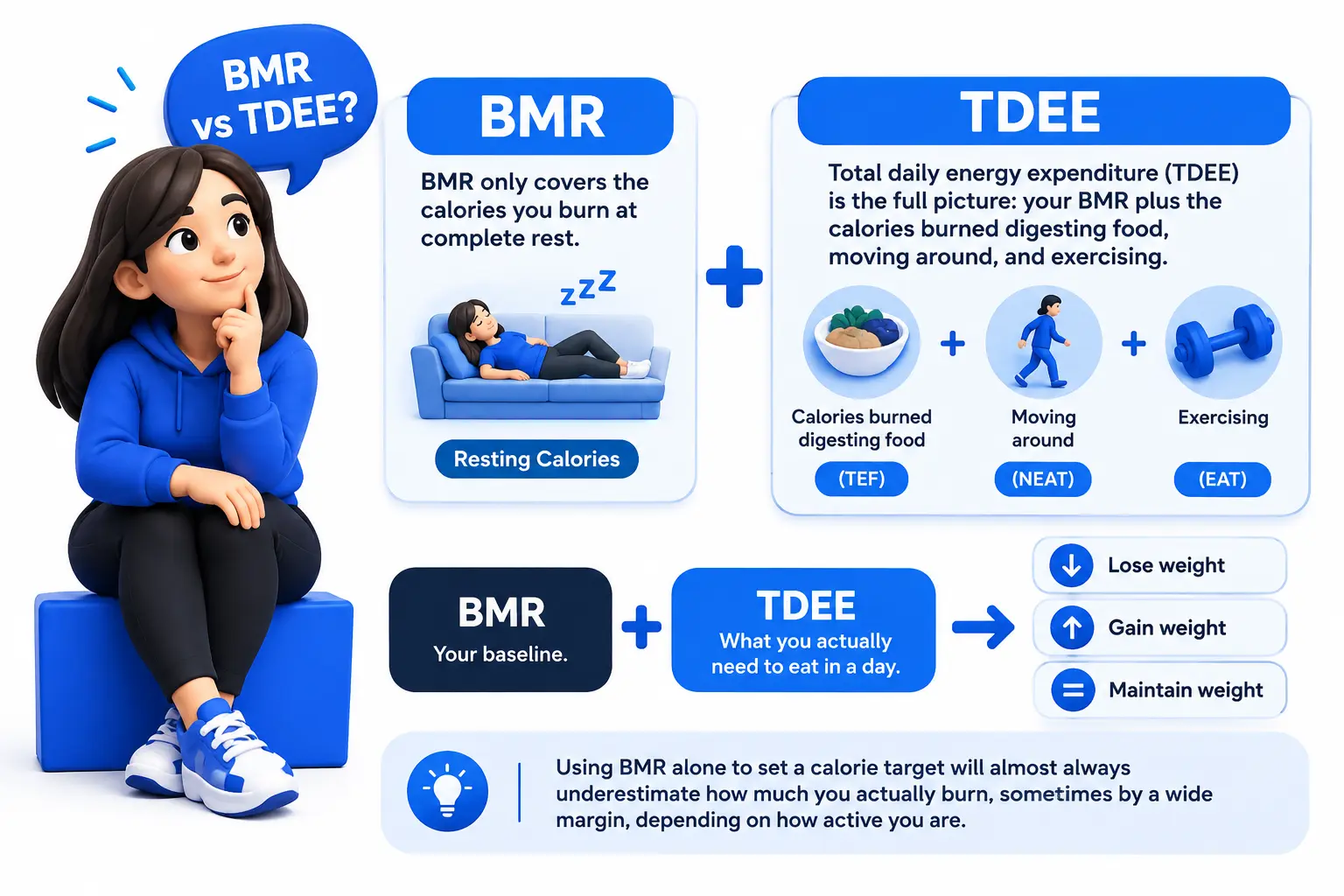
A combined BMR and TDEE calculator shows the difference between your resting calorie needs and total daily calorie needs. BMR is your baseline, while TDEE accounts for daily movement, digestion, and exercise—helping you set a more accurate calorie target for weight loss, gain, or maintenance.
How to Calculate TDEE from BMR
Once you have your BMR, calculating TDEE from BMR is a matter of multiplying it by an activity factor that reflects how much you move in a typical week. In other words, this is a TDEE calculator using BMR as its starting point, not a separate, independent calculation.
Activity Level (Common 5 – Tier System)
|
Activity Level |
Description |
Multiplier |
|
Sedentary |
Little or no exercise, mostly a desk job |
× 1.2 |
|
Lightly active |
Light exercise or sports 1-3 days a week |
× 1.375 |
|
Moderately active |
Moderate exercise or sports 3-5 days a week |
× 1.55 |
|
Very active |
Hard exercise or sports 6-7 days a week |
× 1.725 |
|
Extra active |
Very hard training, a physical job, or twice-daily workouts |
× 1.9 |
DRI Physical Activity Level (4-Tier System)
|
Activity Level |
Multiplier Range |
|
Sedentary |
1.0 to 1.4 |
|
Low active |
1.4 to 1.6 |
|
Active |
1.6 to 1.9 |
|
Very active |
1.9 to 2.5 |
Both systems estimate energy needs based on activity levels. Five-level scales provide more detailed activity categories, while four-level PAL systems use fewer, broader categories to classify daily physical activity.
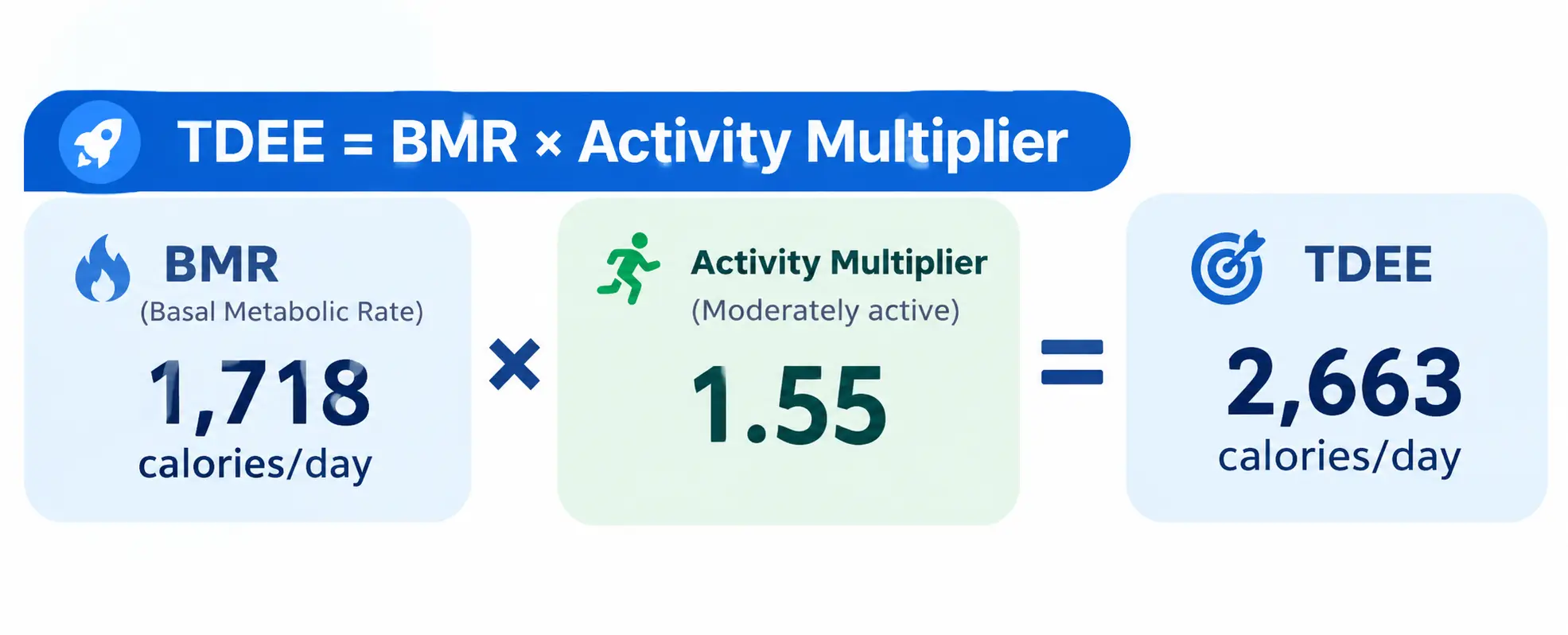

Key Takeaway
Both systems link energy needs to activity, with five-level scales offering more detail than four-level PAL systems.
TDEE= BMR ×Activity Multiplier
A simple formula for a more accurate calorie target
Use your TDEE to set your daily calorie intake for weight loss, gain or maintenance.
Using BMR and TDEE to Reach Your Goals
Once you know your TDEE, adjusting it toward a specific goal is straightforward.
For weight loss
Eat below your TDEE. A 500–1,000 calorie daily deficit may support gradual weight loss, but very low intake can cause muscle loss and slow metabolism.
For weight gain
Eat above your TDEE, typically by around 200 to 300 calories a day, paired with resistance training so the extra energy goes toward building muscle rather than mostly fat.
For maintenance:
Eat close to your TDEE and adjust in small increments as your weight, activity level, or age change.
A couple of practical notes apply across all three goals. Your BMR and TDEE shift as your body changes, so it’s worth recalculating every few months, especially after a meaningful weight change. And consistently eating below your BMR itself, not just your TDEE, generally isn’t recommended, since your body needs that baseline energy just to keep its essential functions running.
Factors That Affect Your BMR
BMR isn’t the same for everyone, and it isn’t fixed even within one person’s lifetime. The Cleveland Clinic groups the influences into a few categories.
Largely fixed factors
- Body size. More body tissue requires more energy to maintain.
- Muscle mass. Muscle is metabolically active tissue and burns more energy at rest than fat does.
- Sex. Men typically have a higher BMR than women, mainly because they tend to carry more lean muscle mass.
- Age. BMR gradually declines with age as muscle mass decreases.
- Genetics. Inherited traits influence metabolic rate, though researchers are still working out exactly how much.
Temporary or situational factors
- Fasting or severe calorie restriction. Your body slows its metabolism to conserve energy, which is part of why very low-calorie diets often backfire over time.
- Environmental temperature. Both cold and heat make your body work harder to maintain a stable internal temperature, which raises BMR.
- Thyroid hormone levels. Higher levels raise BMR; lower levels reduce it.
- Illness or injury. BMR rises as the body fights infection or repairs tissue.
- Stimulants. Caffeine, nicotine, and similar substances can temporarily raise BMR.
Life stages
- Growth, pregnancy, and lactation all increase BMR to support the additional tissue growth or milk production involved.
- Menopause is associated with a decline in BMR, tied to hormonal shifts and a drop in lean muscle mass.
How to Increase Your Basal Metabolic Rate
You can’t override your genetics, age, or height, but a few things genuinely move the needle.
Build muscle through resistance training
Muscle tissue requires more energy to maintain than fat, so more of it raises your baseline calorie burn. This is the most reliable, evidence-backed lever available.
Avoid prolonged, severe calorie restriction
Crash diets can meaningfully lower BMR as your body adapts to conserve energy.
Eat enough protein
Protein has a higher thermic effect than carbs or fat, meaning your body spends more energy digesting it, and adequate protein also supports the muscle mass that keeps BMR up.
Prioritize sleep
Poor sleep is linked to shifts in the hormones that regulate metabolism and appetite.
Be skeptical of anything promising a dramatic metabolism “boost.”
Most of these strategies increase BMR only modestly. Building muscle, eating enough protein, avoiding extreme calorie restriction, and getting quality sleep can support a healthy metabolism, but lasting consistency over months matters far more than any single trick or “metabolism boost.”
BMR vs. RMR: What’s the Difference?
BMR and resting metabolic rate (RMR) get used interchangeably in everyday conversation, but they’re technically different measurements. BMR requires strict lab conditions: a 12 to 14 hour fast, complete physical and mental rest, and a thermally neutral room. RMR is measured under more relaxed conditions and includes the small amount of energy used for basic activities like sitting up or getting dressed.
Because of that, RMR runs slightly higher than BMR, by about 10% according to the Cleveland Clinic. In practice, calculators that reference “resting metabolic rate” and those that reference “basal metabolic rate” are usually producing very similar estimates from the same handful of formulas.
What Your BMR Doesn’t Tell You
A BMR number is genuinely useful, but it’s easy to read more into it than it can actually support.
- It doesn’t equal your total calorie burn. That’s TDEE, which layers activity and digestion on top of BMR.
- It doesn’t describe your body composition. Two people can share the same BMR with very different amounts of muscle and fat, since BMR is a single number produced by a formula, not a full metabolic profile.
- It doesn’t guarantee a specific rate of weight change. Weight change depends on total energy balance over time, not on BMR by itself.
- It’s an estimate, not a measurement. Even the best available equations are built on population averages. A study in the American Journal of Clinical Nutrition found that after accounting for known factors like fat-free mass, fat mass, and age, about 26% of the variation in BMR between individuals remained unexplained. That’s a useful reminder that any calculator, including this one, gives you a well-informed estimate rather than an exact figure. If you need a precise number for medical reasons, indirect calorimetry performed by a healthcare provider remains the gold standard.