
Know Your Calories. Reach Your Goals. Free. No Sign Up.
TDEE Calculator: Find Your Total Daily Calories Burn
How your maintenance calories change with activity. Your selected level is highlighted.
| Activity level | Calories / day |
|---|
Body mass index is a general screening measure of weight relative to height.
Estimated with four widely referenced formulas, plus their average.
| Formula | Ideal weight |
|---|
Suggested daily protein, carb and fat targets for three common goals.
Daily calories needed to lose or gain weight at different paces.
To lose weight
| Pace | Per day | Per week |
|---|
To gain weight
| Pace | Per day | Per week |
|---|
One or more targets above fall below commonly recommended minimums (about 1,200 cal/day for women, 1,500 cal/day for men). Very low-calorie diets should only be followed under medical supervision.
Private by design. Every calculation runs in your browser and nothing you enter is stored on a server.
Your TDEE (Total Daily Energy Expenditure) is the total number of calories your body burns in a full 24-hour day — including rest, digestion, and movement. A TDEE calculator estimates this number using your age, sex, height, weight, and activity level, then runs it through a validated formula such as the Mifflin-St Jeor equation.
Once you know your TDEE, everything else in a nutrition plan becomes simple math: eat below it to lose weight, at it to maintain, or above it to build muscle. Below is a free, straightforward breakdown of the calculation methodology, how TDEE compares to BMR, a real example, and exactly how to use your number — whether your goal is fat loss, maintenance, or muscle gain.
What Is TDEE (Total Daily Energy Expenditure)?
TDEE is the sum of every calorie your body uses in a day. It’s made up of four components, and most people are surprised by how small a role exercise actually plays.

BMR
Calories burned at complete rest — breathing, circulation, organ function.
60–70% of TDEE

NEAT
Walking, fidgeting, chores, standing — everyday movement outside the gym.
15–30% of TDEE

TEF
Energy used to digest, absorb, and metabolize what you eat.
~10% of TDEE

EAT
Calories burned during structured workouts.
10% of TDEE
This is why two people who “work out the same amount” can have very different TDEEs — daily movement (NEAT) and body size usually matter more than the hour spent at the gym.
Learn How Many Calories You Burn Every Day
Your daily calorie burn is your total daily energy expenditure (TDEE). It includes the calories your body uses at rest, during everyday movement, while exercising, and while digesting food. Your TDEE is different from person to person because it depends on factors such as body size, age, sex, muscle mass, activity level, and daily movement.
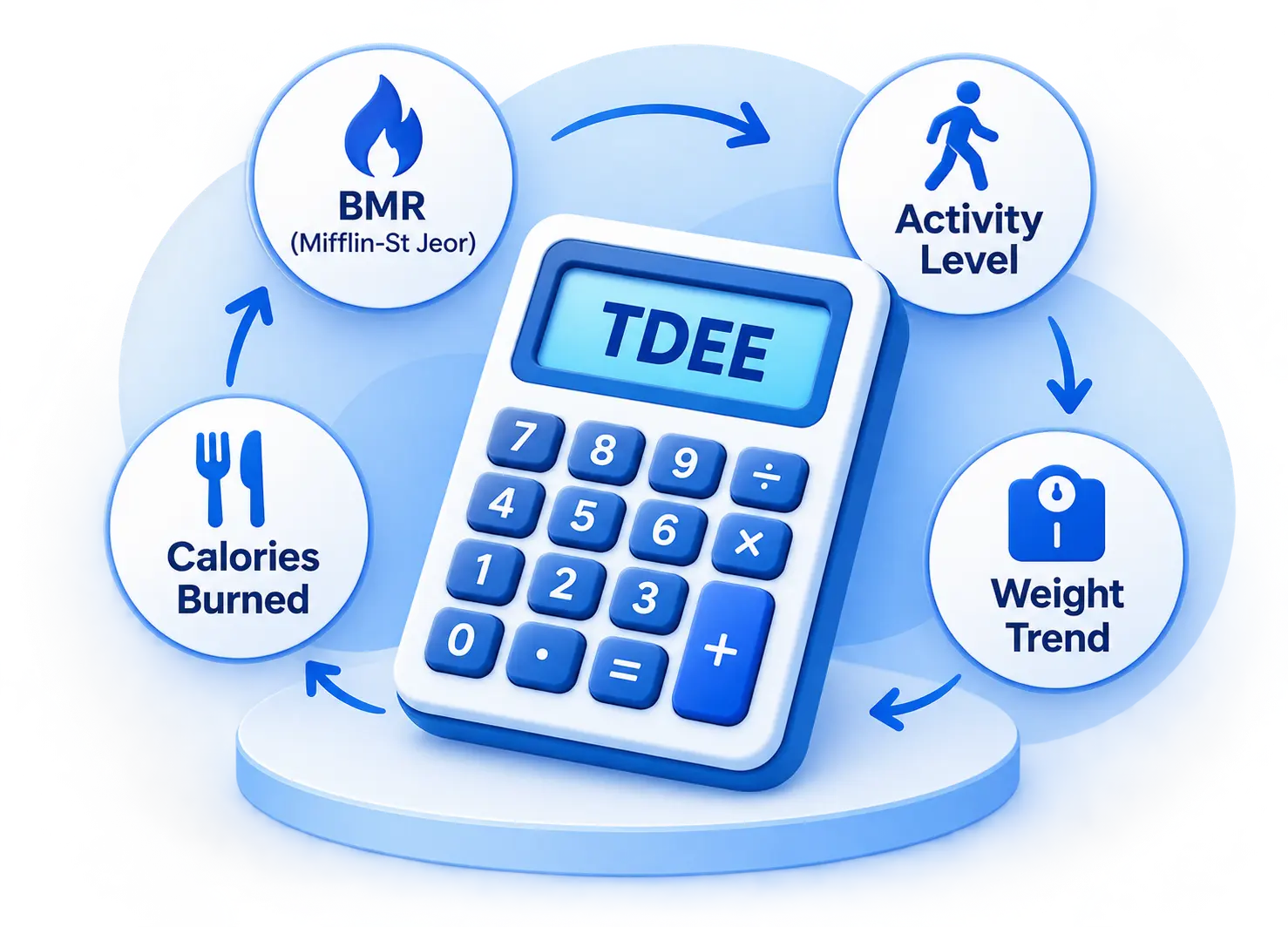
A tdee calculator free tool estimates this number by first calculating your BMR and then applying an activity multiplier. In other words, when you calculate TDEE, you are estimating how much energy your body needs over a complete 24-hour period.
If you’re wondering, “what is my TDEE?”, the easiest approach is to use an online TDEE calculator. Enter your age, sex, height, weight, and activity level to get an estimate of your daily calorie needs. You can then use that number as the starting point for maintenance, weight loss, or muscle gain.
For example, if your estimated TDEE is 2,300 calories, eating around 2,300 calories per day would theoretically maintain your current weight. Eating below that level creates a calorie deficit, while eating above it creates a calorie surplus.
This is why a free TDEE calculator can be useful before setting a calorie target. Rather than choosing an arbitrary number, you have an estimate based on your individual measurements.
TDEE Calculator Methodology
Here’s exactly how this TDEE calculator — and the guidance in this article — arrives at your number, so the math isn’t a black box.
The two-step method. Every trustworthy TDEE calculator estimates your Basal Metabolic Rate first, then scales it up with an activity multiplier. Neither step is a guess; both run on published, peer-reviewed formulas rather than proprietary guesswork.
Step 1: Estimate BMR With Mifflin-St Jeor Equation
This methodology uses the Mifflin-St Jeor equation, the formula most dietitians, clinicians, and the American Council on Exercise (ACE) point to as the most accurate for the general population. It replaced the older 1919 Harris-Benedict formula in most modern tools because head-to-head validation research found it predicts measured resting energy expenditure more closely across a wide range of body types.
- Men: BMR = (10 × weight in kg) + (6.25 × height in cm) − (5 × age in years) + 5
- Women: BMR = (10 × weight in kg) + (6.25 × height in cm) − (5 × age in years) − 161
A widely cited systematic review in the Journal of the American Dietetic Association found Mifflin-St Jeor predicted measured BMR within 10% accuracy for the large majority of both non-obese and obese adults — a better hit rate than Harris-Benedict or Katch-McArdle in most comparisons.
Step 2: Apply an Activity Multiplier
|
Activity Level |
Description |
Multiplier |
|
Sedentary |
Desk job, little to no exercise |
×1.2 |
|
Lightly active |
Light exercise 1–3 days/week |
×1.375 |
|
Moderately active |
Moderate exercise 3–5 days/week |
×1.55 |
|
Very active |
Hard exercise 6–7 days/week |
×1.725 |
|
Extra active |
Physical job + daily intense training |
×1.9 |
TDEE = BMR × Activity Multiplier. These tiers follow the FAO/WHO/UNU framework for human energy requirements — the same reference point most clinical and consumer calculators are built on.
Why the Methodology Matters
Two calculators can ask identical questions and still disagree, usually because one still runs the outdated Harris-Benedict formula or rounds activity tiers differently. If you know your body fat percentage, look for a calculator that offers the Katch-McArdle formula instead — it’s built on lean body mass rather than total weight, which makes it more precise for very lean or very muscular people. Whichever formula is used, treat the output as an estimate with a realistic 10–15% margin of error, not a lab measurement.
What Affects Your TDEE?
Several factors influence your total daily energy expenditure, so your TDEE is not a fixed number that stays the same forever.
Because these factors change, the number from a tdee calculator should be treated as an estimate rather than a permanent calorie prescription.
How Accurate Is This Calculator?
A useful estimate for your nutrition plan – not an exact number.
A tdee calculator accurate enough for everyday nutrition planning can give you a useful starting estimate, but no calculator can measure your exact calorie expenditure from a few personal inputs.

Use It As a Starting Point
Your Tdee estimate is usefull for building an initial calorie type.
How it Works
A tdeecalculato typically estimates BMR using an equation such as Mifflin-St Jeor and then multiplies that result by an activity factor. The final number depends heavily on how accurately you describe your usual activity level.

Activity Level Matters
For example, selecting “very active“ when most of your day is spent sitting can make the estimated TDEE higher than your actual energy expenditure. Likewise, choosing “sedentary” when you walk many thousands of steps every day may underestimate your needs.
Track and Adjust
The best way to use a tdee calculator online is to treat the result as a starting point. Follow your calorie intake and body-weight trend for several weeks. If your actual results consistently differ from what the calculator predicts, you can make a small adjustment to your calorie target.
Your Real World Results Matter
Your actual real-world results are especially useful because they reflect your individual metabolism, movement, food intake, and routine rather than relying only on population averages.
TDEE vs BMR: What’s the Difference?
A BMR calculator only tells you how many calories you’d burn lying in bed all day doing nothing. A TDEE calculator takes that BMR and adds your real-world activity — your job, workouts, and daily movement — to give you the actual number of calories you burn. If you’re building a diet plan, TDEE is the number that matters; BMR is just the input used to get there.
|
BMR |
TDEE |
|
|
What it measures |
Calories burned at complete rest |
Calories burned across a full day, activity included |
|
Includes exercise or daily movement? |
No |
Yes |
|
Right number for a calorie target? |
No — usually too low to diet around |
Yes — this is the number you eat toward |
|
Typical size vs. the other |
Baseline |
20–90% higher than BMR, depending on activity level |
For example, someone with a BMR of 1,500 calories who trains four times a week might land closer to a 2,300-calorie TDEE — nearly 50% higher. Setting a diet target around BMR instead of TDEE is one of the most common calorie-counting mistakes, since it manufactures a far bigger deficit than intended and often backfires as fatigue, plateaus, or bingeing.
TDEE vs BMI
Different number. Different Purpose.

TDEE
Estimate how many calories your body uses in a typical day.

BMI
A weight- to- hight screening measure .
TDEE and BMI measure completely different things. TDEE estimates how many calories your body uses in a typical day, while BMI is a weight-to-height screening measure. TDEE is primarily used for estimating calorie needs and setting nutrition targets. BMI does not tell you how many calories you burn and cannot be used as a substitute for a tdee calculator.
Remember
TDEE =Calories Burned and BMI=Weight relative to height

For Example
Two people can have the same BMI but have different TDEEs because they have different ages, sexes, body compositions, activity levels, and daily routines.
|
Measure |
What it tells you |
Main use |
|
TDEE |
Estimated calories burned per day |
Setting calorie and nutrition targets |
|
BMR |
Estimated calories needed at complete rest |
Starting point for TDEE calculation |
|
BMI |
Weight relative to height |
General weight-status screening |
If your goal is calorie planning, calculate my TDEE is the more relevant question than using BMI to determine how many calories you should eat.
A tdee calculator weight loss estimate can help you establish a starting calorie target, while BMI may provide additional context about weight relative to height. Neither measurement tells the complete story about health or body composition.
How to Use Your TDEE
Once you have your number, it becomes the anchor for every goal — you’re simply adding or subtracting calories from the same baseline.
Aggressive fat loss
Calorie Target: TDEE − 750 to 1,000
~1.5–2 lbs/week
Recommended
Moderate fat loss
Calorie Target: TDEE − 500
~1 lb/week
Maintenance
Calorie Target: = TDEE
~1.5–2 lbs/week
Lean muscle gain
Calorie Target: TDEE + 200 to 300
~0.25–0.5 lbs/week
For Weight Loss
A TDEE calculator for weight loss uses your TDEE to set a calorie deficit. A 500-calorie daily deficit is a common starting point, helping support steady weight loss while preserving muscle and energy. Avoid extreme calorie restriction.
For Maintenance
Eating at your TDEE holds your weight steady. This is the right target if you’re happy with your current weight, coming off a diet phase, or deliberately taking a break between a cut and a bulk to let hunger cues and metabolism reset before the next push.
For Muscle Gain
Add 200–300 calories on top of your TDEE to fuel lean muscle growth without piling on excess fat. Pair that surplus with progressive resistance training — extra calories without a reason to build muscle mostly just add body fat.
How to Increase Your TDEE
You cannot dramatically change your TDEE overnight, but you can increase your daily energy expenditure by becoming more active and maintaining or building lean muscle mass.
Move More Every Day
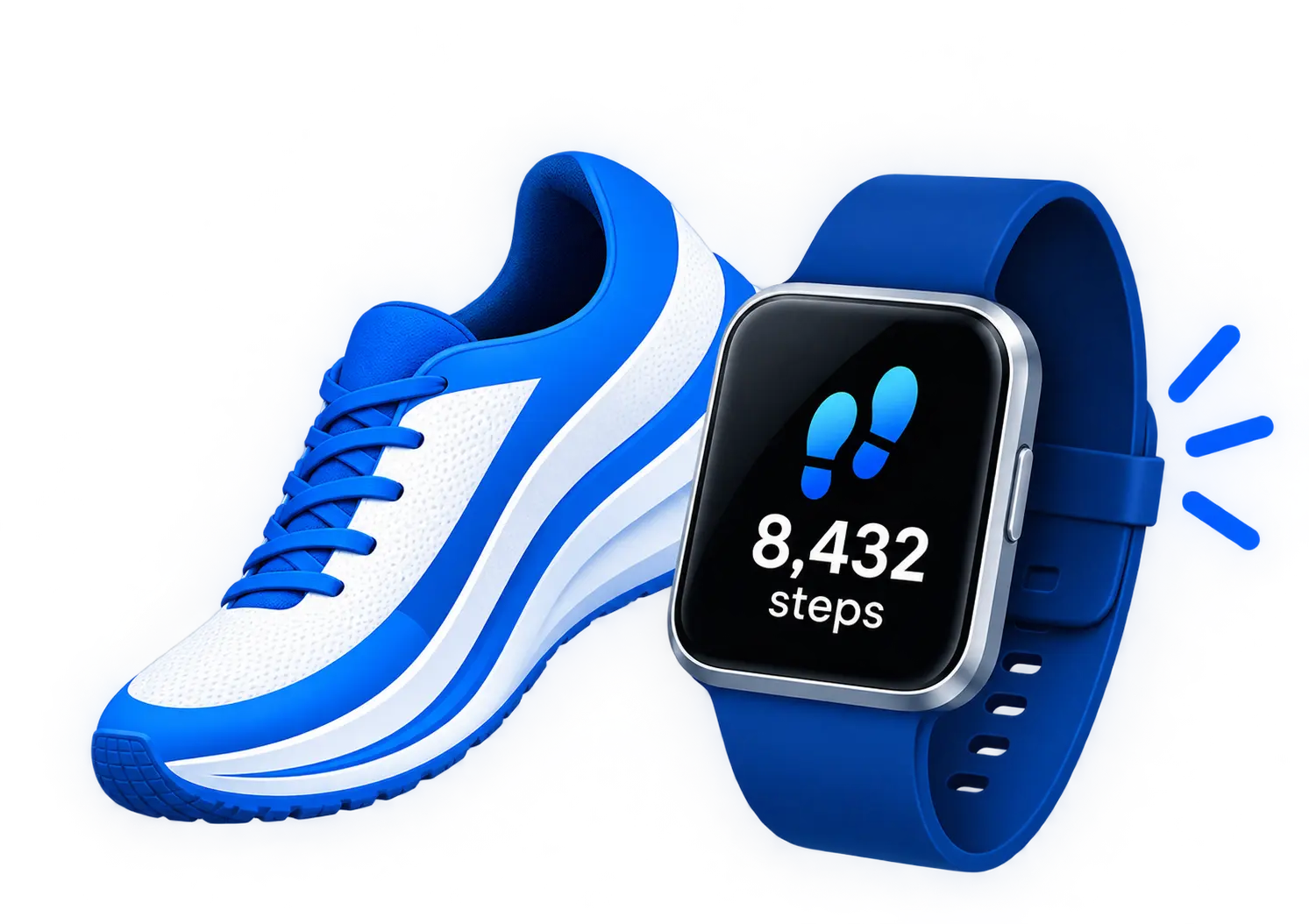
Increase NEAT by walking more, taking the stairs, standing regularly, doing household tasks, and sitting less throughout the day.

Add Strength Training
Resistance training helps build muscle and boost energy use. Combine it with walking, cardio, sports, or activities you enjoy.
You Don’t Need Hours
You don’t need hours of exercise to raise TDEE. Consistent daily movement can be more practical than intense workouts.
Use Tdee For Weight Loss
A TDEE calculator helps plan weight loss by balancing a calorie deficit with regular walking, strength training, and daily activity.

Keep Recalculating
Remember that your TDEE will still change as your body weight, fitness, activity, and routine change. Recalculate your estimated needs periodically rather than assuming the original number will remain accurate forever.
How to Split Your TDEE Into Macros
Your calorie total decides which way the scale moves. The split decides how bearable the process is — and how much of what you gain or lose is fat rather than muscle. Protein and carbohydrate each provide about 4 calories per gram, while fat provides about 9, so two plates hitting the same calorie target can look nothing alike.
|
Split |
Protein / Fat / Carb |
Best For |
|
Moderate carb |
30% / 35% / 35% |
The default — fine for most people and most training |
|
Lower carb |
40% / 40% / 20% |
Fewer, heavier meals, or watching blood sugar |
|
Higher carb |
30% / 20% / 50% |
Long training sessions or high training volume |
Keep protein at roughly 1.6 g per kg of body weight (about 0.7 g per pound), and push it toward the higher end while cutting — that’s the part that protects muscle when calories are low.
Cutting and Bulking: Setting Your Pace
Cutting is eating under your TDEE; bulking is eating over it. The size of the gap sets the pace of the change.
|
Approach |
Daily Adjustment |
Typical Pace |
|
Cut |
−500 kcal/day |
~0.5 kg (1 lb)/week — noticeable, but most people can hold it for a while |
|
Mild cut |
−250 kcal/day |
~0.25 kg (0.5 lb)/week — slower, much easier to live with, training barely affected |
|
Mild bulk |
+250 kcal/day |
Lean gaining — very little of it arrives as fat |
|
Bulk |
+500 kcal/day |
Faster on the scale, but a bigger share of that is fat |
Give whichever approach you pick three or four weeks before judging it — one bad week means nothing. Recalculate once your weight has shifted by 5 to 10 kg (10 to 20 lbs), since a lighter (or heavier) body burns a different number of calories and the old target quietly stops matching your goal. And don’t go under 1,200 calories a day without a doctor involved.
Free Online TDEE Calculator: What Makes One Accurate
Not every online TDEE calculator is built the same way. When you use a free TDEE calculator, check that it:
- Uses the Mifflin-St Jeor equation (the current clinical standard) rather than the outdated 1919 Harris-Benedict formula
- Lets you select an honest activity level — most people overestimate this, which is the single biggest source of error
- Offers a Katch-McArdle option if you know your body fat percentage, since it’s more precise for lean or very muscular individuals
- Shows your BMR, TDEE, and calorie targets separately, not just one final number
The formula behind a free tool and a paid app is usually identical — it’s arithmetic, not proprietary technology. What actually varies between calculators is the interface, the extra features (macros, BMI, saved history), and whether the activity descriptions are clear enough for you to pick accurately.
Real-World TDEE Example (Step by Step)
Meet Sara: 34 years old, 5’5″ (165 cm), 154 lbs (70 kg), works a desk job but trains 3 times a week (moderately active).
- BMR = (10 × 70) + (6.25 × 165) − (5 × 34) − 161 = 700 + 1,031.25 − 170 − 161 = 1,400 kcal
- TDEE = 1,400 × 1.55 (moderately active) = 2,170 kcal/day
- Weight-loss target = 2,170 − 500 = 1,670 kcal/day
That 1,670-calorie target isn’t a guess — it’s grounded in Sara’s actual stats and a scientifically supported deficit. This is exactly what a TDEE calc does for anyone, instantly.
Common Mistakes When Using a TDEE Calculator
Overestimating activity level
Most people who “work out 3 times a week” are still closer to lightly active once the rest of their day is sedentary.
Eating below BMR
Dropping under your resting metabolic rate — even in a rush to lose weight fast — risks fatigue, muscle loss, etc.
Never recalculating
Your TDEE drops as you lose weight because a smaller body burns fewer calories. Recalculate every 10–15 lbs of change.
Treating the number as exact
TDEE is an estimate. Track weight for 2–3 weeks and adjust calories by 100–200 if needed.
Key Takeaways
- TDEE = the total calories you burn daily, combining BMR, NEAT, TEF, and exercise.
- The Mifflin-St Jeor equation is the current gold-standard formula used in most accurate TDEE calculators.
- BMR typically makes up 60–70% of TDEE — daily movement matters more than most people think.
- Recalculate your TDEE every 10–15 lbs of weight change for continued accuracy.
- TDEE usually runs 20–90% higher than BMR depending on activity level — always build your calorie target around TDEE, never BMR alone.
- For weight loss, a 500-calorie deficit below TDEE is a safe, sustainable, evidence-backed starting point.
- A free online TDEE calculator is just as mathematically accurate as a paid one — accuracy comes from honest inputs, not price.