
TDEE Calculator With Steps
Most calorie calculators ask you to pick an activity level from a dropdown and then multiply. That works fine if your daily movement is predictable. It falls apart when you have a desk job but walk 14,000 steps, or when you train hard four days a week and barely move on the other three.
A TDEE calculator with steps solves that by treating walking as a measured input instead of a guess. You enter your step count, the tool converts it to calories using your body weight, and that number gets added to a baseline built from your BMR. The result is usually closer to reality than a dropdown guess, provided you avoid one specific mistake that most step-based calculators make.
How your maintenance calories change with activity. Your selected level is highlighted.
| Activity level | Calories / day |
|---|
Body mass index is a general screening measure of weight relative to height.
Estimated with four widely referenced formulas, plus their average.
| Formula | Ideal weight |
|---|
Suggested daily protein, carb and fat targets for three common goals.
Daily calories needed to lose or gain weight at different paces.
To lose weight
| Pace | Per day | Per week |
|---|
To gain weight
| Pace | Per day | Per week |
|---|
One or more targets above fall below commonly recommended minimums (about 1,200 cal/day for women, 1,500 cal/day for men). Very low-calorie diets should only be followed under medical supervision.
Private by design. Every calculation runs in your browser and nothing you enter is stored on a server.
What TDEE Actually Measures
Total Daily Energy Expenditure is everything your body burns in 24 hours. It breaks into four parts, and only one of them is affected by your step count.
BMR
It covers breathing, circulation, organ function, and cell maintenance.
Roughly 60 to 70% Of Tdee
TEF
It covers Digesting, absorbing, and storing what you eat.
About 10% Of Tdee
NEAT
It covers Walking, standing, fidgeting, chores, commuting.
Highly variable Of Tdee
Exercise activity
It covers Deliberate training sessions.
0 to 10%+ Of Tdee
The thermic effect of food sits near 10% of total daily energy expenditure for most people eating a mixed diet, though protein-heavy meals push it higher than carbohydrate or fat.
Steps land almost entirely in the NEAT bucket. That is also the component with the widest spread between individuals, which is exactly why measuring it beats estimating it.
Resting Metabolic Rate (RMR)
Resting Metabolic Rate (RMR) is the energy your body needs to maintain essential functions while you are at rest. It includes processes such as breathing, circulation, organ function, and maintaining body temperature.
RMR is closely related to BMR (Basal Metabolic Rate), although the two terms are not technically identical. Your RMR provides the starting point for estimating how many calories your body needs before adding movement, exercise, and digestion.
For most people, this calculator uses the Mifflin-St Jeor equation to estimate resting calorie needs. If reliable body-fat data is available, the Katch-McArdle equation can also be considered.
How a TDEE Calculator With Steps Works
Stage 1: BMR
Mifflin-St Jeor (default): Men = 10×wt(kg) + 6.25×ht(cm) − 5×age + 5; Women: same − 161. Most accurate for most people, but ~30% of estimates can still be off by 10%+.
Katch-McArdle: BMR = 370 + 21.6×lean mass(kg). Needs accurate body fat % (DEXA scan ideal) — a 10% error in body fat can shift BMR by ~170 cal.
Stage 2: Activity Multiplier
Use 1.2 (sedentary) as your base — not moderate/active levels — because those already include walking. Adding steps on top of a higher multiplier double-counts movement.
Stage 3: Step Calories
Converted separately (covered in detail elsewhere) — this is the key adjustment that makes a step-based calculator different from a standard one.
Stage 4: Exercise Calories
Add structured workouts (lifting, cycling, etc.) separately, since steps don’t capture them well. Total weekly exercise calories ÷ 7 = daily average.
Formula:
TDEE = (BMR × 1.2) + step calories + average daily exercise calorie
The Double-Counting Problem
Two overlapping errors cause step-based calculators to overshoot, sometimes by 400 calories or more.

Multiplier Plus Steps
If your activity level already includes lots of walking, adding step calories again will overestimate your total calorie needs.

Gross Calories Instead Of Net Calories
Walking calories often include energy you would have burned at rest. Since BMR is already part of TDEE, this can count resting calories twice.
The Fix: Use Net Calories
Net calories represent the energy burned from walking above your resting metabolism.
|
Measure |
Estimate |
|
Gross calories(total burn during the walk) |
About 470 |
|
Resting calories during that same time |
About 125 |
|
Net calories(what you add to TDEE) |
About 345 |
Why Its Matters:
The 125-calories difference add up to nearly 900 calories per week. A step-based TDEE calculator should add the net figure, not the gross walking calories.
The Math Behind Step Calories
MET values for walking
A MET, or metabolic equivalent of task, expresses the energy cost of an activity as a multiple of resting metabolism. One MET is roughly 1 calorie per kilogram of body weight per hour. The 2024 Adult Compendium of Physical Activities, the third major update to a reference database first published in 1993, lists these values for level walking on a firm surface:
|
Walking pace |
2024 Compendium MET value |
|
Under 2.0 mph, strolling |
2.3 |
|
2.0 to 2.4 mph, slow |
2.8 |
|
2.5 mph |
3.0 |
|
2.8 to 3.4 mph, moderate |
3.8 |
|
3.5 to 3.9 mph, brisk |
4.8 |
|
4.0 to 4.4 mph, very brisk |
5.5 |
|
Stair climbing, general |
6.8 |
|
Climbing hills, 1 to 5% grade, moderate to brisk |
5.3 |

2024 Update Changes
Several of these values changed in the 2024 update.
- Moderate walking rose from 3.5 to 3.8 METs
- Brisk walking rose from 4.3 to 4.8
Calculators still quoting the 2011 figures will run slightly low.
Steps to Distance:

Step length varies with height, sex, and pace. The commonly repeated “2,000 steps per mile” is a rounded approximation. A study published in ACSM’s Health & Fitness Journal in 2008 measured one-mile step counts across walking and running speeds and found the number varies predictably with sex, height, and pace, averaging roughly 2,250 steps per mile at a 20-minute-mile walking pace. For walking, most adults fall somewhere between 1,900 and 2,500 steps per mile.
Notably, that same research found a slow jogger at a 12-minute-mile pace can take more steps per mile than a fast walker at a 15-minute-mile pace, because the jogging stride is shorter and bouncier.
Putting it together
Net calories =
(MET − 1) × weight in kg × hours walked
Work that through for a moderate pace and typical step length, and it reduces to a simple coefficient:
Net step calories ≈ steps × weight in kg × 0.0004
That comes out to roughly 0.03 net calories per step for a 150 lb person and about 0.045 for a 250 lb person. You will see figures of 0.04 to 0.05 calories per step quoted widely, but those are gross values, not net, and they assume an average body weight rather than yours.
Calories Burned by Step Count
These estimates use the net calculation above at a moderate walking pace of roughly 3 mph. Treat them as starting points, not precise measurements.
|
Body weight |
Per 1,000 steps |
5,000 steps |
7,000 steps |
10,000 steps |
15,000 steps |
|
130 lb (59 kg) |
24 |
120 |
170 |
240 |
360 |
|
150 lb (68 kg) |
28 |
140 |
195 |
280 |
420 |
|
170 lb (77 kg) |
32 |
160 |
220 |
315 |
475 |
|
190 lb (86 kg) |
35 |
175 |
245 |
355 |
530 |
|
210 lb (95 kg) |
39 |
195 |
275 |
390 |
585 |
|
230 lb (104 kg) |
43 |
215 |
300 |
425 |
640 |
|
250 lb (113 kg) |
46 |
230 |
325 |
465 |
695 |
Body weight is the dominant variable. A 250 lb person burns roughly twice what a 130 lb person burns over the same distance, because the energy cost of walking scales with the mass being moved.
Pace Matters More Than Most Tools Admit
Most step-to-calorie conversions assume a single average pace. In practice, the difference between a shuffle and a brisk walk is substantial. Here is what 1,000 steps costs a 170 lb (77 kg) walker at different speeds:
|
Pace |
Net calories per 1,000 steps |
|
2.5 mph (24-minute mile) |
26 |
|
3.0 mph (20-minute mile) |
32 |
|
3.5 mph (17-minute mile) |
40 |
|
4.0 mph (15-minute mile) |
43 |
Over 10,000 steps that spread is about 170 calories. If your tracker records pace or active minutes, use them. If you mostly accumulate steps slowly around the house or office, use the lower end of the range.
Hills and stairs add more. Climbing at a 1 to 5% grade at a moderate pace runs 5.3 METs against 3.8 on the flat, and general stair climbing sits at 6.8 METs.
Worked Example
Profile: 35-year-old woman, 5 ft 5 in (165 cm), 150 lb (68 kg), desk job, no structured exercise, averaging 9,000 steps per day.
Step 1. BMR using Mifflin-St Jeor
BMR = (10 × 68) + (6.25 × 165) − (5 × 35) − 161
BMR = 680 + 1,031 − 175 − 161
BMR = 1,375 calories
Step 2. Baseline multiplier
1,375 × 1.2 = 1,650 calories
Step 3. Step calories (net)
68 kg × 9,000 steps × 0.0004 = 245 calories
Step 4. Exercise
None to add.
Step 5. Total
TDEE ≈ 1,650 + 245 = 1,895, call it 1,900 calories
How that compares to other methods
The same woman, calculated five different ways:
|
Method |
Result |
|
Mifflin-St Jeor × 1.2, plus 9,000 net step calories |
1,895 |
|
Mifflin-St Jeor × 1.375 (lightly active), no step adjustment |
1,891 |
|
Mifflin-St Jeor × 1.55 (moderately active), no step adjustment |
2,132 |
|
National Academies 2023 EER, inactive |
2,080 |
|
National Academies 2023 EER, low active |
2,245 |
Two things stand out. First, the step-based calculation lands almost exactly on the “lightly active” multiplier, which is a useful sanity check and confirms that 9,000 steps with no training is light activity rather than moderate. Second, the federal equations produce noticeably higher numbers, which brings us to a source of confusion most calculators ignore entirely.
The Equations Most Calculators Do Not Use
In January 2023, the National Academies of Sciences, Engineering, and Medicine published an update to the Dietary Reference Intakes for Energy, replacing values that had stood since 2005. The new Estimated Energy Requirement equations were built from doubly labelled water data, the benchmark method for measuring free-living energy expenditure, rather than from BMR multiplied by an activity factor.
For adults 19 and over:
|
Sex |
Activity level |
EER equation (kcal/day) |
|
Men |
Inactive |
753.07 − (10.83 × age) + (6.50 × height cm) + (14.10 × weight kg) |
|
Men |
Low active |
581.47 − (10.83 × age) + (8.30 × height) + (14.94 × weight) |
|
Men |
Active |
1,004.82 − (10.83 × age) + (6.52 × height) + (15.91 × weight) |
|
Men |
Very active |
−517.88 − (10.83 × age) + (15.61 × height) + (19.11 × weight) |
|
Women |
Inactive |
584.90 − (7.01 × age) + (5.72 × height cm) + (11.71 × weight kg) |
|
Women |
Low active |
575.77 − (7.01 × age) + (6.60 × height) + (12.14 × weight) |
|
Women |
Active |
710.25 − (7.01 × age) + (6.54 × height) + (12.34 × weight) |
|
Women |
Very active |
511.83 − (7.01 × age) + (9.07 × height) + (12.56 × weight) |
The committee also reported how much individual requirements scatter around these predictions. The standard error of the predicted value is 342 calories per day for men and 241 for women. In practical terms, about 95% of women matching a given profile have actual requirements within roughly 470 calories either side of the predicted number. For men the window is about 670 calories wide on each side.
That is the honest uncertainty range on any calculated TDEE, whether it comes from these equations or from BMR times a multiplier. No calculator escapes it.
Reading the activity categories
The four categories in the federal equations are defined as quartiles of measured activity levels, not as gym schedules. The report describes them this way:
- Inactive: minimally active beyond daily living, little or no occupational activity
- Low active: adds roughly 60 to 80 minutes of moderate walking per day
- Active: adds another 30 to 50 minutes of walking plus about 85 minutes of vigorous activity
- Very active: adds more than two hours of vigorous activity
An older analysis of 574 doubly labeled water measurements, cited in the same report, describes it from the lifestyle side: sitting work with little or no strenuous leisure sits around 1.4, work with discretion to move but little strenuous leisure sits around 1.6 to 1.7, standing work with substantial movement sits around 1.8 to 1.9, and strenuous work or highly active leisure reaches 2.0 to 2.4.
Most people who describe themselves as “moderately active” are, by these definitions, low active.
How Accurate Is a Step-Based TDEE Estimate?
Honest answer: a step-based TDEE estimate is more useful than simply choosing an activity level from a dropdown, but it is not precise enough to be treated as an exact number. Your daily calorie needs can change based on walking pace, body weight, workout intensity, metabolism, and how active you are outside of your recorded steps.
That makes a step-based TDEE calculator best viewed as a starting point rather than a final answer. Use the estimate to set an initial calorie target, then track your body weight and adjust the number based on real-world results. Over several weeks, your weight trend can help you determine whether the estimated TDEE is reasonably close to your actual energy needs.

Your step count is probably close
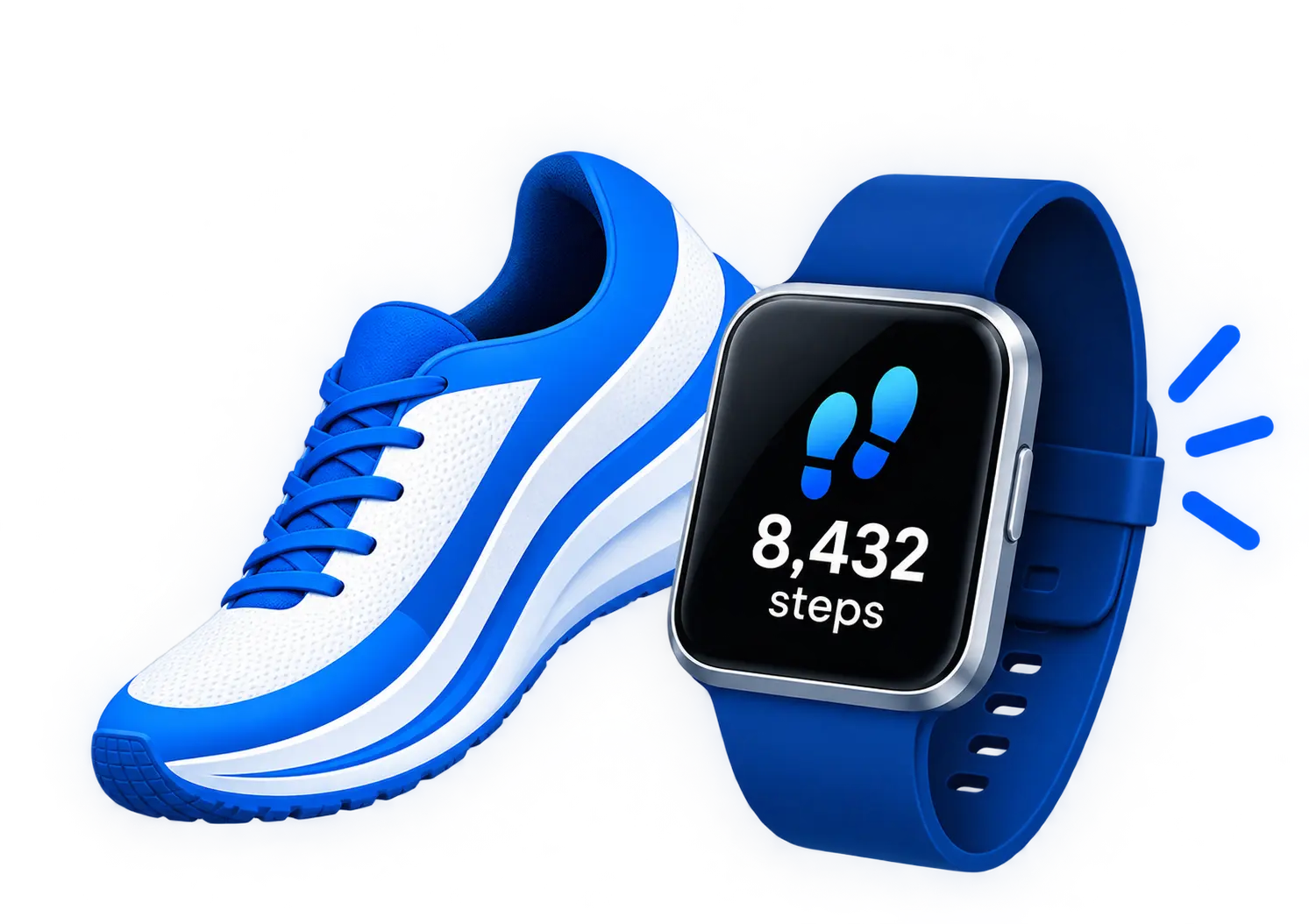
Consumer wearables measure steps reasonably well. A 2025 meta-analysis of Apple Watch accuracy reported a mean absolute percentage error of about 8% for step counts and 4% for heart rate. Step accuracy for steady-state walking now commonly falls under 5% on modern devices.
Your tracker’s calorie figure is probably not
The same meta-analysis found ~28% energy expenditure error. A JMIR review of Fitbit, Apple, Garmin, Samsung, and Polar found no brand met acceptable accuracy limits. Another review reported >30% mean absolute percentage error for energy expenditure across all brands tested.

Why Step-based Is Often better
This is why a step-based calculation built from MET values and your body weight is often better than the calorie number your watch displays. The step count is the reliable input. The calorie estimate is not.
Device placement changes the number
Hip and waist-worn devices and wrist-worn devices do not produce identical step counts, and neither do different algorithms applied to the same raw data. If you switch trackers, expect your baseline to shift.
Steps alone cannot classify your activity level
The 2023 National Academies committee looked specifically at whether step counts could be used to assign someone to an activity category and concluded that associations between measured activity level and accessible measures such as steps were generally weak. Their finding was blunt: no valid, reliable tool currently exists for classifying an individual’s physical activity level. Steps are a good measure of walking volume. They are an incomplete measure of total activity.
Turning Your TDEE Into a Calorie Target
Your TDEE is the maintenance number. What you do with it depends on the goal.
|
Goal |
Daily intake |
Expected rate |
|
Fat loss, moderate |
TDEE − 300 to 500 |
Roughly 0.5 to 1 lb per week initially |
|
Fat loss, aggressive |
TDEE − 500 to 750 |
Faster early, harder to sustain, more lean mass risk |
|
Maintenance |
TDEE |
Stable weight |
|
Lean gaining |
TDEE + 200 to 350 |
Slow gain with less fat accumulation |

Why your weight loss slows even when you stay consistent
The “3,500 calories equals one pound” rule is still repeated everywhere. It is wrong in a specific and predictable way. Researchers at the National Institutes of Health have shown that the rule’s core failure is not the number 3,500 but its assumption that your energy deficit stays constant. It does not. As you lose weight your body gets smaller, your BMR drops, and moving costs less energy. The deficit shrinks even if your intake never changes.
Applied over a year, the static rule substantially overstates how much weight someone will lose. The NIH Body Weight Planner exists specifically because of this, using a dynamic model that accounts for how expenditure adapts over time.
The practical consequence for you: expect your rate of loss to slow, and recalculate when it does. That is normal physiology, not failure.
Macros come after calories
Once you have a calorie target, the National Academies’ Acceptable Macronutrient Distribution Ranges give the broad boundaries for adults: 45 to 65% of calories from carbohydrate, 20 to 35% from fat, and 10 to 35% from protein. Those ranges are deliberately wide. There is no single split that guarantees fat loss, and total intake over time matters far more than the ratio. People in a deficit often shift toward the upper end of the protein range to support lean mass retention and fullness.
How Many Steps Should You Actually Aim For?
The 10,000-step target came from a 1960s Japanese pedometer marketing campaign, not from research. The evidence now points somewhat lower.
A systematic review and dose-response meta-analysis published in The Lancet Public Health in 2025 pooled 57 studies covering more than 160,000 adults and examined step counts against eight health outcomes. Compared with 2,000 steps per day, roughly 7,000 steps was associated with risk reductions ranging from 6% to 47% across every outcome examined, including all-cause mortality, cardiovascular disease, type 2 diabetes, dementia, depression, and falls.
Benefits started appearing at around 4,000 steps. For most outcomes the curve flattened near 7,000. For cardiovascular disease specifically, benefits continued to increase beyond that point.
For calorie purposes, more steps still means more expenditure with no plateau. For health purposes, 7,000 is a defensible target and 4,000 is meaningfully better than 2,000. Separately, the Physical Activity Guidelines for Americans recommend at least 150 minutes of moderate-intensity activity per week, and the National Academies committee noted that activity categories used for calorie equations do not map cleanly onto those guidelines.
Getting a More Accurate Number
Five things will improve your estimate more than switching calculators:
Average your steps over 7 to 14 days
A single day tells you nothing. Weekends usually differ from weekdays by thousands of steps.
Measure your actual step length
Walk 100 yards, count your steps, then multiply by 17.6 to estimate steps per mile.

Log structured exercise separately
Do not let your watch fold a lifting session into a step-derived total.
Weigh yourself consistently
Same time of day, same conditions, and compare weekly averages rather than single readings.

Adjust from observed results
After 2–3 weeks, compare weight change with your target and adjust calories based on results.
That last point is the one that matters most. Every equation on this page produces an estimate with a wide confidence interval. Your own trend data is the only measurement specific to you.
When to Recalculate
- After a weight change of about 10 lb in either direction
- When your average step count shifts by 2,000 or more per day for a sustained period
- After starting, stopping, or substantially changing a training program
- Every 4 to 6 weeks during an active fat loss or gaining phase
- After a change in job, commute, or living situation that alters your daily movement
- After a change in body composition, if you are using the Katch-McArdle equation
Common Mistakes

Adding step calories to a high activity multiplier
The single most expensive error. Use 1.2 as your base when you count steps separately.
Using gross walking calories
Adds resting metabolism twice, so use net calorie-burn figures for accurate estimates.
Trusting your watch’s calorie readout
Step counts are solid. Calorie estimates carry roughly 30% error.
Assuming 2,000 steps per mile
Real values run from about 1,900 to 2,500 for walking, depending on your height and pace.
Picking your best week as your baseline
Use a realistic average, including the days you barely moved.
Treating the output as a measurement
Federal equations have a 241–342 calorie error. Treat your number as a testable hypothesis.