
Calorie Deficit Calculator: Calories to Lose Weight
A calorie deficit calculator turns a few pieces of information, your age, sex, height, weight, and activity level, into a personalized number: how many calories to eat each day to lose weight at a pace you can actually sustain. Enter your details in the calculator above and it estimates your Total Daily Energy Expenditure (TDEE), the number of calories your body burns just existing and moving through a normal day, then builds a daily target around whatever deficit fits your goal.
Know about what happens behind that number: how the math works, why a 500-calorie deficit doesn’t always translate into exactly one pound of fat loss a week, and how to size your deficit so it’s big enough to make progress without leaving you exhausted, hungry, or stuck on a plateau.
How your maintenance calories change with activity. Your selected level is highlighted.
| Activity level | Calories / day |
|---|
Body mass index is a general screening measure of weight relative to height.
Estimated with four widely referenced formulas, plus their average.
| Formula | Ideal weight |
|---|
Suggested daily protein, carb and fat targets for three common goals.
Daily calories needed to lose or gain weight at different paces.
To lose weight
| Pace | Per day | Per week |
|---|
To gain weight
| Pace | Per day | Per week |
|---|
One or more targets above fall below commonly recommended minimums (about 1,200 cal/day for women, 1,500 cal/day for men). Very low-calorie diets should only be followed under medical supervision.
Private by design. Every calculation runs in your browser and nothing you enter is stored on a server.
What Is a Calorie Deficit?
A calorie deficit happens when you consistently eat fewer calories than your body uses in a day. Once intake drops below that amount, your body makes up the difference by breaking down stored energy, mostly body fat along with some lean tissue, to keep functioning normally. That process is what eventually shows up on the scale as weight loss.
The number your body burns in a day, your TDEE, is made up of three parts
Basal Metabolic Rate (BMR)
Your body’s energy needs at complete rest to keep vital organs working, making up about 60%–75% of daily calorie burn.
Physical activity
Everything from structured workouts to walking, fidgeting, and daily chores. This usually makes up another 20% to 30%.
Thermic effect of food (TEF)
The energy spent digesting and processing what you eat, roughly 5% to 10% of the total.
A deficit can come from eating less, moving more, or, most practically, some combination of both. Weight gain works the same way in reverse: eating more than your TDEE creates a calorie surplus, and the extra energy gets stored, mostly as fat.
Food Energy Converter
Calories are a way of measuring energy. A food’s calorie value tells you how much energy your body can obtain from that food, although the amount your body actually uses can vary depending on digestion, preparation, and other individual factors.

Kilojoules vs. calories
A food energy converter is useful when a nutrition label or food database uses kilojoules instead of calories. One kilocalorie (kcal), which is what nutrition labels generally mean when they say “Calories,” equals approximately 4.184 kilojoules (kJ).
|
Energy |
Equivalent |
|
1 kcal |
4.184 kJ |
|
100 kcal |
418.4 kJ |
|
500 kcal |
2,092 kJ |
|
1,000 kcal |
4,184 kJ |
|
2,000 kcal |
8,368 kJ |
Your Daily Calories Calculator
Your daily energy requirement is more useful than looking at any single food in isolation. A daily calorie calculator estimates how much energy you need based on your age, sex, height, weight, and activity level. You can then compare that estimate with the calories you consume.
Whether you call it a calorie calc, cal calculator, or calorie estimator, the underlying goal is the same: estimate your energy needs so you can make a more informed nutrition plan
How a Calorie Deficit Calculator Works
Getting from basic stats to a daily calorie number takes three steps, and it’s exactly what this calculator does automatically.
Step 1: Estimate your BMR
Three formulas are commonly used to estimate BMR, each with different data requirements and a different level of accuracy:
|
Formula |
What it needs |
Notes |
|
Mifflin-St Jeor |
Weight, height, age, sex |
Considered the most reliable general-purpose formula. A 2005 systematic review in the Journal of the American Dietetic Association found it predicted measured resting metabolic rate within 10% more often than the alternatives below, in both non-obese and obese adults. This calculator uses it as the default. |
|
Revised Harris-Benedict |
Weight, height, age, sex |
An older formula, originally published in 1919 and revised in 1984. Generally considered less accurate than Mifflin-St Jeor for most people, though it’s still widely used. |
|
Katch-McArdle |
Weight, body fat percentage |
Uses lean body mass instead of total weight, which can make it more accurate for leaner or more muscular people, provided the body fat percentage entered is reasonably precise. |
Three formulas are commonly used to estimate BMR, each with different data requirements and a different level of accuracy: For reference, the equations behind these formulas use weight in kilograms, height in centimeters, and age in years:
Mifflin-St Jeor
Men: (10 x weight) + (6.25 x height) – (5 x age) + 5.
Women: (10 x weight) + (6.25 x height) – (5 x age) – 161.
Revised Harris-Benedict
Men: (13.397 x weight) + (4.799 x height) – (5.677 x age) + 88.362.
Women: (9.247 x weight) + (3.098 x height) – (4.330 x age) + 447.593
Katch-McArdle
370 + (21.6 x lean body mass in kg), where lean body mass equals weight multiplied by (1 minus body fat percentage as a decimal).
You don’t need to run these by hand. The calculator converts pounds to kilograms and feet and inches to centimeters automatically, then applies the formula that fits the information you provide.
Step 2: Multiply by an activity factor
Once you have a BMR estimate, it gets multiplied by an activity factor to estimate TDEE:
|
Activity level |
What it typically looks like |
Multiplier |
|
Sedentary |
Little to no exercise, a desk-based job, most of the day spent sitting |
x1.2 |
|
Lightly active |
Light exercise or sports 1 to 3 days a week, or a job that keeps you on your feet part of the day |
x1.375 |
|
Moderately active |
Moderate exercise 3 to 5 days a week, such as brisk walking, cycling, or dancing |
x1.55 |
|
Very active |
Hard exercise or sports 6 to 7 days a week |
x1.725 |
|
Extremely active |
Very intense daily training, twice-a-day workouts, or a physically demanding job on top of regular exercise |
x1.9 |
Multiply your BMR by the number that matches your activity level and you have your TDEE, the calories needed to maintain your current weight.
Step 3: Subtract calories for your goal
Creating a deficit means subtracting calories from your TDEE. The table below shows how different daily deficits translate into weekly pace, based on the traditional estimate that a pound of body fat represents about 3,500 calories.
|
Daily deficit |
Weekly deficit |
Textbook weekly loss |
Notes |
|
250 calories |
1,750 calories |
About 0.5 lb |
Gradual and easy to sustain |
|
500 calories |
3,500 calories |
About 1 lb |
The most commonly recommended starting point |
|
750 calories |
5,250 calories |
About 1.5 lb |
Faster, but harder to sustain for most people |
|
1,000 calories |
7,000 calories |
About 2 lb |
Widely considered the upper limit; most health guidance advises against going further |
These figures come from the traditional 3,500-calorie-per-pound rule, and they tend to overstate how much weight most people actually lose, especially over several months. The next section explains why.
Calorie Counting as a Means for Weight Loss
Weight loss generally requires a consistent calorie deficit, meaning you consume fewer calories than your body uses. A calorie calculator for weight loss estimates your maintenance calories and then suggests a reasonable deficit.
For example
If your estimated maintenance is 2,400 calories per day, eating around 1,900 calories would create an estimated 500-calorie daily deficit. However, this does not guarantee exactly one pound of weight loss each week because water, body composition, activity, metabolism, and energy expenditure can affect results.
The Basic Equation
Calories Deficit=
Maintainance calories – Daliy calories intake
Example:
2,400 maintenance calories − 1,900 calories eaten = 500-calorie deficit.
How to Calculate Calorie Deficit
To understand how to calculate calorie deficit, follow three steps:
- Estimate your maintenance calories.
- Choose a reasonable daily deficit.
- Subtract the deficit from your maintenance calories.
A moderate deficit of roughly 300–750 calories per day can be a practical starting range for many adults. Larger deficits are not automatically better and may make it harder to meet protein, vitamin, mineral, and energy needs. Your weight trend over several weeks is more useful than relying on a single calculator result.
Calorie Calculator: Estimate Your Daily Calorie Needs
The calculator above asks for a handful of details: your sex, age, height, current weight, activity level, and, if you’re working toward a specific number, your goal weight. From there, it works through a few steps:
- It estimates your Basal Metabolic Rate (BMR), the energy your body needs just to keep your organs running at complete rest.
- It multiplies that number by an activity factor to estimate your TDEE, or maintenance calories: the amount you’d eat to hold your current weight steady.
- It subtracts a calorie deficit from your TDEE to give you a daily target for weight loss, along with an estimated timeline for reaching your goal weight.
You can switch between imperial and metric units, and the calculator handles the conversions automatically. Because the output is built on population-level formulas rather than a lab measurement, treat it as a strong starting point rather than an exact prescription. Your real-world results will depend on things a calculator can’t measure directly, including genetics, sleep quality, stress, and how your particular body responds to a given diet.
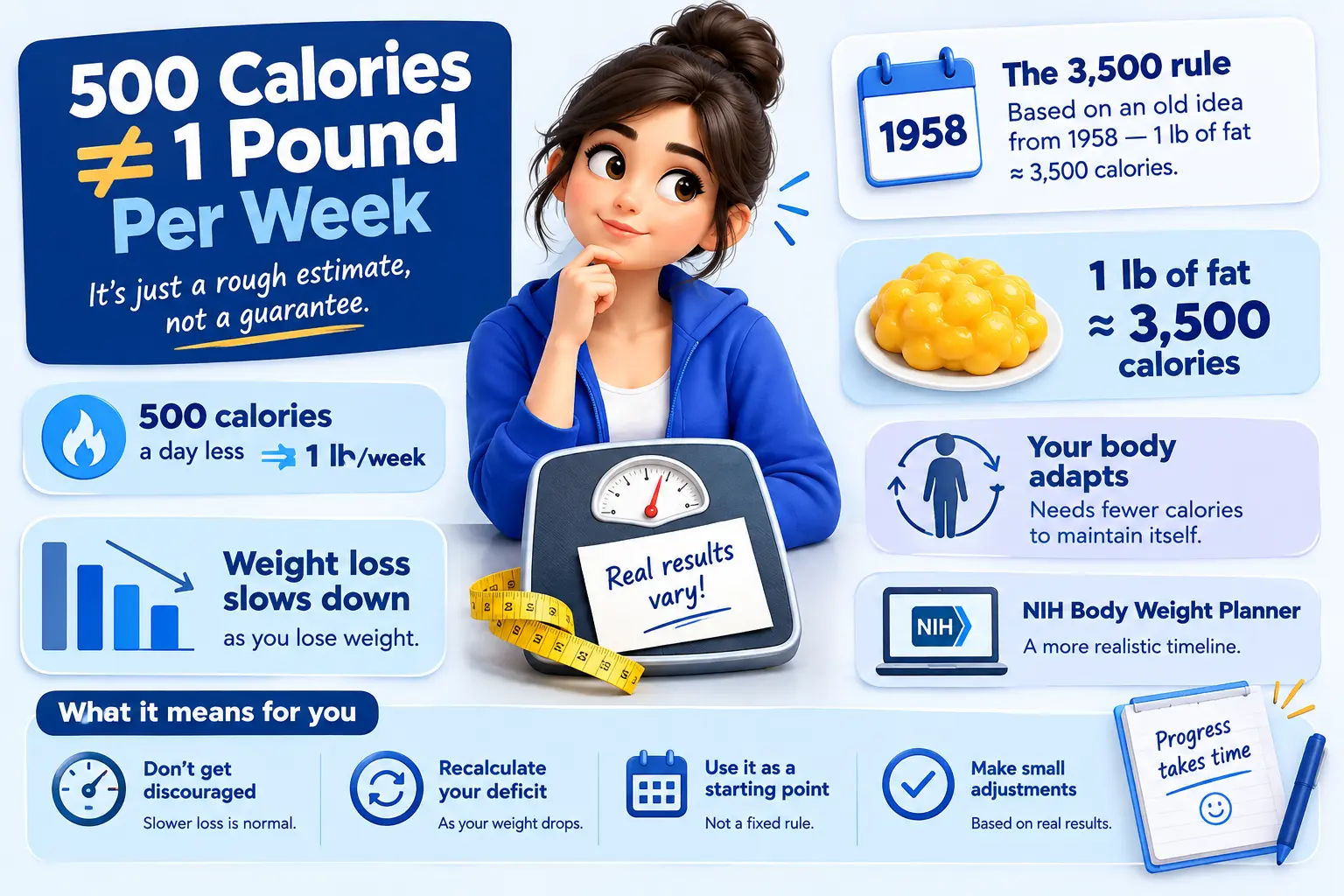
Does a 500-Calorie Deficit Really Equal a Pound a Week?
The idea that a 500-calorie daily deficit equals one pound of fat loss per week comes from the old 3,500-calorie rule. While useful as a starting estimate, it isn’t a precise prediction. Research shows weight loss slows over time as the body adapts and requires fewer calories at a lower weight. So, treat the 500-calorie rule as a rough guide and recalculate your calorie needs periodically based on your actual progress.
How Many Calories Do You Need Per Day?
Daily calorie needs vary widely by age, sex, height, weight, and activity level, which is exactly why a personalized calculator beats a single number. Still, some general reference points are useful context.
As a broad range, adult men typically need somewhere between 2,000 and 3,000 calories a day to maintain their weight, while adult women typically fall between 1,600 and 2,400. A commonly cited average, and the figure used on U.S. Nutrition Facts labels, is 2,000 calories a day for women and 2,500 for men, though very few people land exactly on those numbers.
Calorie needs also decline gradually with age as BMR slows. The table below reflects the general pattern published in the 2020-2025 edition of the federal Dietary Guidelines for Americans, based on Institute of Medicine energy-requirement equations for moderately active adults.
|
Age |
Men |
Women |
|
19-25 |
2,800 |
2,200 |
|
26-45 |
2,600 |
2,000 |
|
46-50 |
2,400 |
2,000 |
|
51-65 |
2,400 |
1,800 |
|
66+ |
2,200 |
1,800 |
It’s worth noting that the newest edition of the Dietary Guidelines for Americans, covering 2025-2030 and released in January 2026, moved away from a single age-based lookup table. It now presents calorie needs as a broader system of calorie levels, from 1,000 to 3,200 calories, meant to be paired with an individual calculation rather than read off a chart by age bracket alone. That shift is part of why a calculator that accounts for your specific height, weight, and activity level, like the one above, gives you a more useful number than any static table can.
A few groups should treat any calculator’s output as a rough estimate and check with a doctor before making changes: people who are pregnant or breastfeeding, competitive athletes, and anyone managing a metabolic condition such as diabetes.
Calories: Different Kinds and Their Effects
Protein, carbohydrates, fat, and alcohol provide different amounts of energy and have different roles in the body:
Protein
Its main role is Muscle repair and maintenance
4 kcal per gram
Carbohydrate
Important energy source
4 kcal per gram
Fat
Energy, cell function, hormones
9 kcal per gram
Alcohol
Energy with few essential nutrients
7 kcal per gram
Two meals with the same calories can have very different nutritional value. Foods containing protein, fiber, vegetables, fruits, whole grains, and healthy fats may provide greater fullness and nutrient value than highly processed foods. A calorie counter is therefore most useful when combined with attention to food quality, protein, fiber, and portion sizes.
2000, 1500, and 1200 Calorie Sample Meal Plans
A calorie target should reflect your individual needs rather than simply choosing a popular number.
2,000-calorie example:
Oatmeal with berries and Greek yogurt for breakfast; chicken, brown rice, and vegetables for lunch; fruit with peanut butter as a snack; and salmon, potatoes, and vegetables for dinner.
1,500-calorie example:
Eggs, whole-grain toast, and fruit for breakfast; chicken salad with beans for lunch; Greek yogurt and berries as a snack; and lean protein with vegetables and rice for dinner.
1,200-calorie diet
A 1,200-calorie diet is relatively low for many adults and should not automatically be considered appropriate. Your calorie needs calculator should help determine a more suitable target.
Calories Burned from Common Exercises
Exercise contributes to calorie expenditure, but actual calories burned vary according to body weight, intensity, duration, fitness level, and movement efficiency. For a person weighing around 154 lb (70 kg), 30 minutes may burn approximately 130–150 calories from moderate walking, 200–250 from moderate cycling, 280–350 from jogging, and 300–400 from running or jumping rope.
A calorie expenditure calculator can provide estimates, but exercise calories should not automatically be “eaten back.”

What’s a Safe, Sustainable Calorie Deficit?
Most nutrition and medical sources converge on a similar range: a daily deficit of roughly 300 to 750 calories works well for most adults, producing steady fat loss of about 0.5 to 1.5 pounds a week without the extreme hunger, fatigue, and muscle loss that come with more aggressive cuts. Multiple sources caution against pushing a deficit past 1,000 calories a day or a pace faster than 2 pounds a week, since weight lost that quickly is more likely to include muscle and water along with fat, and the pace is harder to maintain.
There’s also a floor on the low end. General guidance widely cited by health organizations puts the minimum around 1,200 calories a day for women and 1,500 for men, the point below which it becomes difficult to meet basic nutrient needs even with a carefully planned diet. The NIH’s own Body Weight Planner tool won’t generate a target below 1,000 calories a day for the same reason. These are floors, not targets. Going lower doesn’t speed up fat loss; it mainly raises the odds of nutrient deficiencies, fatigue, and rebound weight gain once normal eating resumes.
This calculator is intended for healthy, non-pregnant adults. If you’re pregnant or breastfeeding, training as a competitive athlete, managing a condition such as diabetes, or under 19, calorie needs work differently, and a conversation with a doctor or registered dietitian will serve you better than any calculator.
Signs Your Deficit Is Too Aggressive
A deficit that’s too large tends to announce itself. Common warning signs include:
- Constant, intrusive hunger that doesn’t ease after the first week or two
- Persistent fatigue or trouble concentrating
- Getting sick more often than usual
- Losing strength in workouts faster than expected
- Poor sleep or feeling cold much of the time
- A weight-loss plateau despite sticking to the plan, often a sign the body has adapted to lower intake
If several of these show up at once, adding back 100 to 200 calories and giving the body a couple of weeks to adjust is usually more productive than pushing through.
Calorie Deficit vs. Maintenance vs. Surplus
|
Goal |
Calorie target |
What it does |
|
Weight loss (deficit) |
TDEE minus 300 to 750 calories |
Forces the body to draw on stored fat, and some lean tissue, for energy |
|
Maintenance |
Equal to TDEE |
Keeps weight stable; a useful baseline before adjusting for a new goal |
|
Muscle gain (surplus) |
TDEE plus roughly 200 to 300 calories |
Supplies extra energy to support muscle growth, ideally paired with resistance training |
If the goal is simply to hold steady at the current weight, the same tool works as a maintenance calorie calculator: skip the deficit and eat close to TDEE instead. Because TDEE shifts with weight, activity level, and age, it’s worth recalculating every few months, or any time a routine changes significantly.
How Can You Create a Healthy Calorie Deficit? 6 Tips
Hitting a calorie number is only part of the picture. These habits make the deficit itself easier to sustain and help protect your results once you get there.
Prioritize protein
Protein supports muscle retention during weight loss and helps manage hunger. A common target is 0.7–1 gram of protein per pound of body weight daily, adjusted for activity and goals.
Build meals around fiber
Vegetables, fruit, legumes, and whole grains add volume and fullness without piling on calories. Most adults do well somewhere in the 25 to 38 gram per day range, depending on age and sex.
Stay active and add resistance training when possible
Regular movement increases your calorie deficit, while strength training helps preserve muscle and maintain metabolism during weight loss.
Protect your sleep
Poor sleep disrupts the hormones that regulate hunger and fullness, which can make a calorie deficit feel far harder than it needs to be. Most adults do best with 7 to 9 hours a night.
Manage stress where you can
Chronic stress affects appetite and cravings in ways that work against a deficit. Simple habits, like a short walk, journaling, or a consistent wind-down routine, can help.
Track trends, not single days
Weight naturally fluctuates from water retention, sodium, and digestion. Weigh in under similar conditions, ideally first thing in the morning, and look at the weekly average instead of reacting to any one reading.
Benefits of Counting Calories
Calorie counting isn’t the right fit for everyone, but for people who find it useful, the biggest benefit is awareness. Many people significantly underestimate how much they eat in a day, and tracking, even for a couple of weeks, tends to reveal patterns that would otherwise stay invisible: oversized portions, calorie-dense drinks, or mindless snacking between meals.


Builds Awareness
Tracking your calories helps you see the real numbers.It reveals hidden eatings habits like oversized portions, calorie-dense drinks, and mindless snacking that you might not notice otherwise.

Leads to Better Choices
Once you see how much a takeout dinner and dessert add up to , smarter substitutions and better portion control tend to follow naturally, without much extra effort.

Provides a Clear Goal
Some people simply prefer having a concrete number to work toward rather than a vaguer goal like “eat less.”
Potential Risks of Counting Calories
Calorie counting isn’t without downsides. Nutrition labels and food databases are estimates, and how many calories your body actually absorbs from a given meal can vary with digestion, gut health, and how food is prepared, so tracked numbers are never perfectly exact.
There’s also a behavioral risk worth naming directly. For some people, calorie tracking can tip into rigid or obsessive territory, and research has linked heavy use of calorie-tracking apps with patterns associated with disordered eating in susceptible individuals. Cycles of aggressive restriction followed by regained weight, sometimes called yo-yo dieting, have also been linked to negative health effects over time. If tracking calories ever starts to feel like it’s controlling your day rather than supporting your goals, it’s worth stepping back and talking with a healthcare provider.
Calories in Common Foods
Having a rough sense of calorie counts for everyday foods makes it much easier to hit a daily target without weighing every bite. These are typical values for common single servings; exact numbers vary by brand and preparation.
|
Food |
Serving |
Calories (approx.) |
|
Apple |
1 medium |
95 |
|
Banana |
1 medium |
105 |
|
Broccoli, cooked |
1 cup |
55 |
|
Chicken breast, skinless, cooked |
3 oz |
165 |
|
Egg |
1 large |
70 |
|
Salmon, cooked |
3 oz |
175 |
|
White rice, cooked |
1 cup |
205 |
|
Brown rice, cooked |
1 cup |
215 |
|
Whole wheat bread |
1 slice |
80 |
|
Peanut butter |
2 tbsp |
190 |
|
Avocado |
1/2 medium |
120 |
|
Greek yogurt, plain |
1 cup |
145 |
|
Almonds |
1 oz (about 23) |
165 |
|
Olive oil |
1 tbsp |
120 |
|
Black coffee |
1 cup |
2 |
|
Whole milk |
1 cup |
150 |
|
Soda |
12 oz can |
150 |
For precise figures on packaged foods, the nutrition label on the package is always more reliable than a general reference table like this one.
Calorie Intake Plan
Once you estimate maintenance calories, adjust your intake according to your goal:
|
Goal |
Starting approach |
|
Weight maintenance |
Around estimated maintenance |
|
Fat loss |
Maintenance minus a moderate deficit |
|
Muscle gain |
Maintenance plus a modest surplus |

For Example
Someone with estimated maintenance calories of 2,400 might begin weight loss around 1,900–2,100 calories, depending on the desired deficit and individual circumstances.

How Many Calories Should I Eat a Day?
There is no single calorie target for everyone. Age, sex, height, body weight, activity level, goal, and body composition all affect calorie needs. A daily calorie needs calculator is therefore more useful than following a generic calorie number.
A weight loss calorie calculator, deficit calculator, or fat loss calculator can provide a useful starting estimate. Track your average weight over several weeks and make small adjustments when necessary. The goal is not to find the lowest possible calorie intake, but an intake that supports steady progress while providing adequate energy and nutrients.
Frequently Asked Questions
Final Thoughts
A calorie deficit is the foundation of weight loss, but the right deficit matters more than simply eating less. Use your TDEE as a starting point, choose a moderate calorie deficit, and adjust your target as your weight and activity change. Focus on protein, fiber, regular movement, sleep, and sustainable habits rather than extreme restriction. Most importantly, treat calculator results as estimates and use your real progress to guide adjustments.